

Spreadsheets are incredibly useful. For many businesses, they are one of the first tools used to organize customers, track orders, manage projects, create reports, or keep important information in one place.
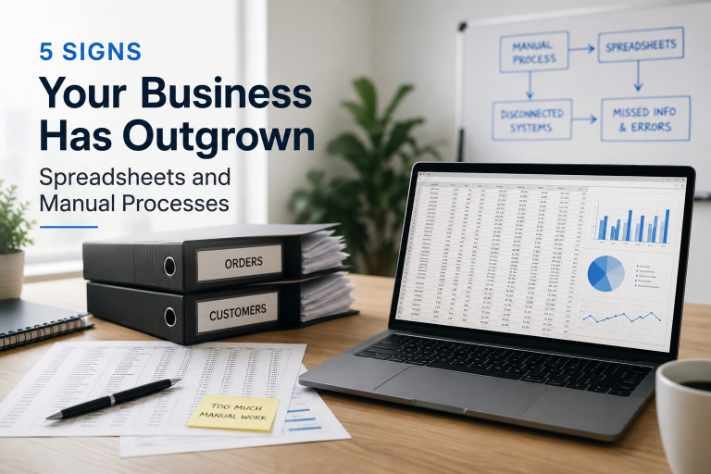
But as a business grows, the same spreadsheets and manual processes that once worked well can start creating more work instead of saving time.
Your team may find themselves copying information between systems, updating multiple files, sending the same reminders, searching through emails, or spending hours preparing reports.
How do you know when your business has reached that point?
Here are five common signs that it may be time to consider a better solution.
1. Your Team Enters the Same Information More Than Once
One of the clearest signs of an inefficient process is duplicate data entry.
For example, a customer submits information through a form. Someone then copies that information into a spreadsheet, enters it into another system, sends an email, and updates a separate report.
Each individual step may only take a few minutes, but repeated dozens or hundreds of times, those minutes quickly add up.
Manual data entry can also increase the possibility of mistakes.
A custom system or integration can often connect these steps so information moves automatically where it needs to go.
Enter information once. Use it everywhere it is needed.
2. Important Information Is Spread Across Multiple Spreadsheets
Many businesses start with one spreadsheet.
Then it becomes five.
Then ten.
Before long, customer information is in one file, payments are tracked somewhere else, tasks are managed in another spreadsheet, and reports require information from several different sources.
This creates common questions:
- Which spreadsheet has the latest information?
- Who updated this record?
- Where is that customer’s information?
- Did someone already complete this task?
- Is this report using the latest data?
When employees spend too much time searching for information, the problem may not be the people or the process.
The business may simply need a better system for organizing its information.
3. Important Processes Depend on One Person
Every business has employees who know exactly how things work.
They know which spreadsheet to update, which customer needs a follow-up, when a report needs to be created, and what needs to happen next.
That knowledge is valuable, but it can also create a problem.
What happens when that person is busy, on vacation, or no longer with the company?
Important business processes should not depend entirely on someone remembering the next step.
Software can help create structured workflows with tasks, reminders, notifications, statuses, and automated actions.
Instead of asking:
“Did someone remember to do this?”
the system can help make sure the next step happens.
4. Creating Reports Takes Too Much Time
A business should be able to understand what is happening without spending hours assembling the information.
But in many companies, reporting means:
- Opening multiple spreadsheets.
- Exporting information from different systems.
- Copying and pasting data.
- Checking formulas.
- Creating charts.
- Sending the final report.
And then doing it all over again next week or next month.
When the information already exists digitally, much of this work can often be automated.
A custom dashboard can bring important business information together and provide the metrics your team actually needs.
Instead of spending time creating the report, your team can spend that time using the information to make decisions.
5. Your Current Software Doesn’t Match the Way Your Business Works
Sometimes the problem isn’t spreadsheets.
You may already be paying for several software platforms.
But your team still uses spreadsheets, emails, notes, and manual workarounds because those systems don’t completely fit the way your business operates.
This is common.
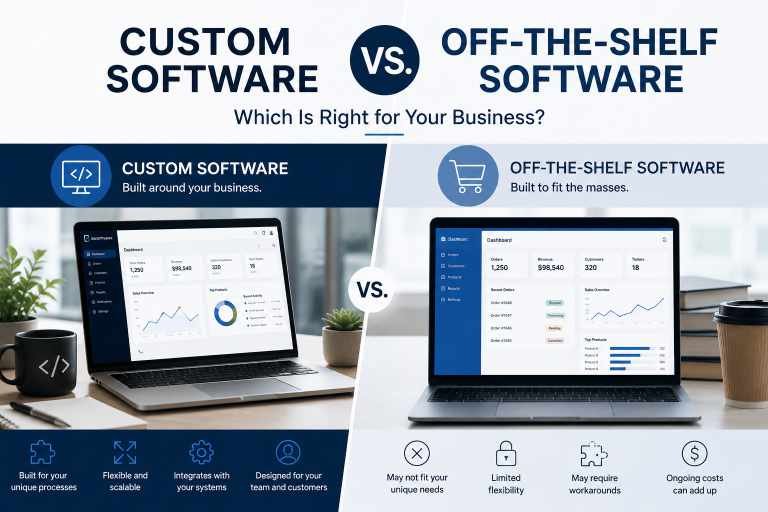
Off-the-shelf software is designed to work for thousands of different businesses. Your processes may be different.
You may need a specific approval process, customer workflow, notification system, report, integration, or internal tool that your existing software doesn’t provide.
When your team spends too much time working around your software, it may be time to consider software designed around your business.
When Does Custom Software Make Sense?
Not every business needs custom software.
If your current tools are simple, inexpensive, and working well, there may be no reason to replace them.
Custom software becomes worth considering when manual processes begin consuming significant time, creating errors, making information difficult to manage, or limiting your ability to grow.
The goal isn’t to replace every spreadsheet or automate everything.
The goal is to identify the processes where technology can make the biggest difference.
Sometimes that means building a complete custom business system.
Other times, the right solution may simply be connecting two existing systems, automating a repetitive workflow, creating a dashboard, or building a small internal tool.
The solution should fit the problem — not the other way around.
Start With One Question
Take a look at how your team works every day and ask:
What repetitive task takes more time than it should?
It could be entering information, following up with customers, preparing reports, updating spreadsheets, sending notifications, organizing documents, or moving information between systems.
That process may be a good place to start.
Ready to Simplify the Way Your Business Works?
At Biz Software, we build custom software and automation solutions around the way your business actually operates.
We start by understanding your processes, identifying opportunities to simplify or automate repetitive work, and designing a solution around your specific needs.
Have a process you’d like to improve?
Let’s talk about your business and explore what could be simplified or automated.